
Deutsch: Panamakanal / Español: Canal de Panamá / Português: Canal do Panamá / Français: Canal de Panama / Italiano: Canale di Panama
The Panama Canal is one of the most critical artificial waterways in global maritime logistics, connecting the Atlantic and Pacific Oceans via a 77-kilometer-long system of locks, lakes, and channels. Constructed to drastically reduce transit times and costs for international shipping, it remains a cornerstone of modern trade infrastructure. Its strategic location and engineering complexity have cemented its role in shaping global mobility and economic dynamics.
General Description
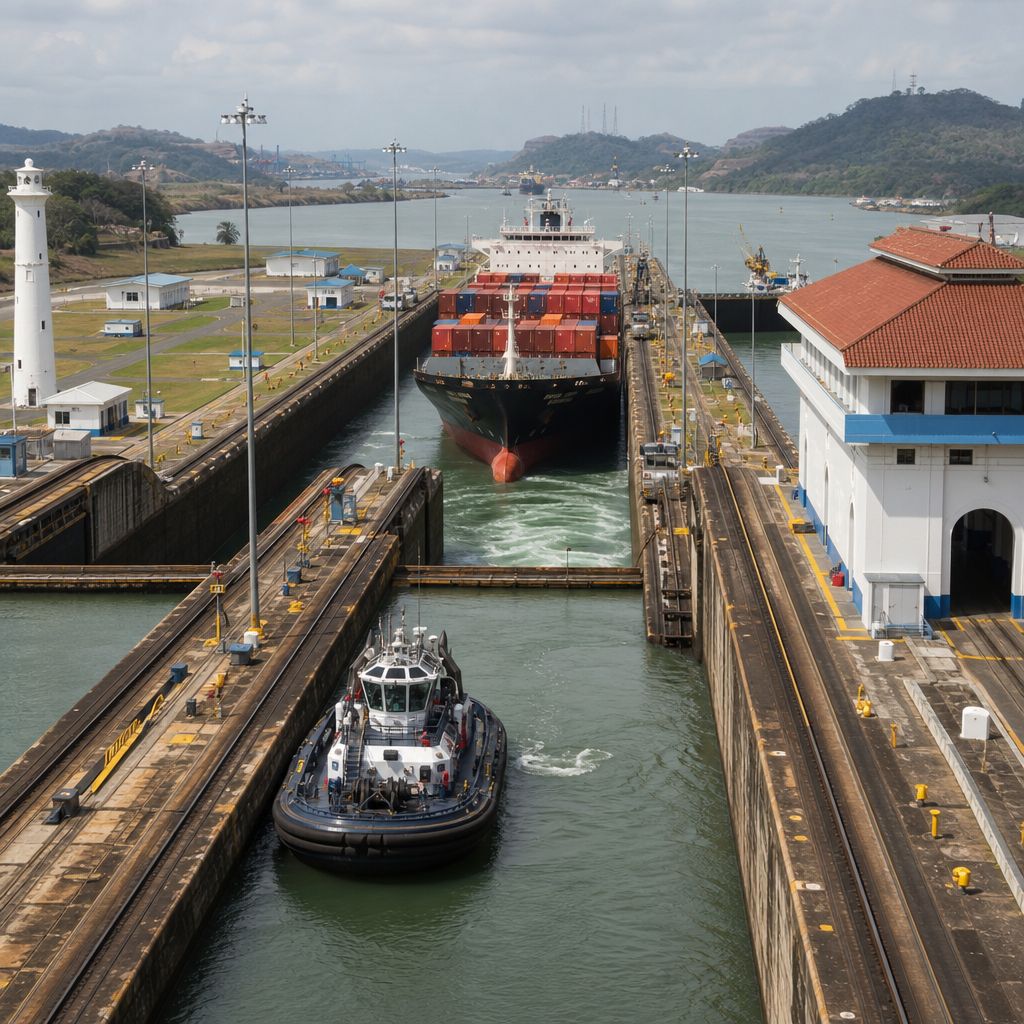
The Panama Canal is a man-made maritime passage in Panama that enables ships to traverse between the Caribbean Sea (Atlantic Ocean) and the Gulf of Panama (Pacific Ocean) without circumnavigating South America's Cape Horn. Completed in 1914 under U.S. administration and later transferred to Panamanian control in 1999, the canal operates as a neutral transit route under the Panama Canal Authority (ACP), adhering to international treaties.
The canal's design incorporates a three-lock system—Gatun, Pedro Miguel, and Miraflores—which elevates vessels 26 meters above sea level to cross the continental divide via Gatun Lake, an artificial freshwater reservoir. This elevation change is managed through a series of water-filled chambers that raise and lower ships sequentially. The canal's original locks, measuring 33.53 meters in width and 320 meters in length, accommodated Panamax-class vessels (maximum dimensions: 294.3 m length × 32.3 m beam × 12.04 m draft).
In 2016, the Expanded Panama Canal (also called the Neo-Panamax project) introduced a third lane with larger locks—427 meters long, 55 meters wide, and 18.3 meters deep—doubling the canal's capacity and allowing New Panamax ships (up to 366 m × 49 m × 15.2 m) to transit. This expansion addressed growing demand from container ships, liquefied natural gas (LNG) carriers, and bulk cargo vessels, reducing bottlenecks and increasing annual transit capacity from ~300 million to ~600 million Panama Canal Universal Measurement System (PC/UMS) tons.
The canal's operation relies on a freshwater system fed by the Chagres River and Gatun Lake, which also supplies drinking water to Panama City and Colón. Each transit consumes ~200 million liters of freshwater, flushed into the oceans via the locks. To mitigate environmental impact, the ACP implements water-saving basins that reuse 60% of the water per transit cycle.
Transit fees, calculated based on vessel type, size, and cargo (using the PC/UMS metric), generate over $2 billion USD annually for Panama's economy. The canal's strategic value is underscored by its role in reducing the New York–Tokyo route by 12,000 kilometers compared to the Cape Horn alternative, saving 10–15 days of transit time and significantly cutting fuel costs.
Technical Specifications
The original locks (Gatun, Pedro Miguel, Miraflores) feature paired chambers to allow bidirectional traffic, with each lock measuring 33.53 meters in width and 320 meters in length. The Culebra Cut (now Gaillard Cut), an 13.7-kilometer artificial valley, was the most challenging excavation during construction, requiring the removal of over 76 million cubic meters of rock and soil. Gatun Lake, covering 425 square kilometers, serves as the canal's central reservoir, maintaining the 26-meter elevation via the Gatun Dam.
The Neo-Panamax locks (Cocolí and Agua Clara), inaugurated in 2016, accommodate vessels with a beam of up to 49 meters and a draft of 15.2 meters, enabling 98% of the world's container fleet to transit. These locks use rolling gates (instead of miter gates) for enhanced durability and water-saving basins that recycle 60% of the water per cycle. The expansion project required 4.4 million cubic meters of concrete—enough to build 1,100 Empire State Buildings—and dredged 150 million cubic meters of material.
The canal's transit process involves a pilot boarding the vessel at the entrance, followed by electric mules (locomotives) guiding ships through the locks via steel cables. Average transit time is 8–10 hours, though delays may occur during peak traffic or maintenance. The ACP employs a reservation system for priority transits, with slots auctioned to the highest bidders during congestion.
Historical Development
The concept of a Central American canal dates to the 16th century, when Spanish explorers sought a route to avoid the treacherous Cape Horn. The French attempt (1881–1894), led by Ferdinand de Lesseps (builder of the Suez Canal), failed due to engineering miscalculations, tropical diseases (malaria, yellow fever), and financial collapse, resulting in ~22,000 worker deaths. The U.S. acquired the project in 1904 after supporting Panama's independence from Colombia, negotiating the Hay-Bunau-Varilla Treaty for perpetual control over the Canal Zone.
Under U.S. leadership, Chief Engineers John F. Stevens and George W. Goethals implemented a lock-based design (replacing the French sea-level plan) and prioritized disease control through mosquito eradication, reducing mortality rates. The canal opened on August 15, 1914, with the SS Ancon as the first official transit. The U.S. administered the canal until December 31, 1999, when the Torrijos-Carter Treaties (1977) transferred sovereignty to Panama, establishing the Panama Canal Authority (ACP) as its operator.
The 2016 expansion, proposed in 2006 and completed at a cost of $5.25 billion USD, was the largest infrastructure project in the canal's history. It addressed capacity limits by introducing the Neo-Panamax locks, designed to handle Post-Panamax vessels carrying up to 14,000 TEUs (twenty-foot equivalent units). The project faced challenges, including concrete quality disputes and labor strikes, but was delivered within 2% of its budget.
Application Area
- Global Shipping: The canal is a vital chokepoint for East-West trade, handling ~3–4% of global maritime commerce annually. Over 14,000 transits occur yearly, with container ships, bulk carriers, and tankers comprising 80% of traffic. The route is critical for U.S. East Coast ports, Asian exports to Europe, and South American commodities (e.g., Chilean copper, Brazilian soy).
- Energy Transport: The canal facilitates the movement of liquefied natural gas (LNG) from the U.S. Gulf Coast to Asia, as well as crude oil from Latin America to global markets. Neo-Panamax locks accommodate 90% of the world's LNG carriers, reducing reliance on the Suez Canal for energy shipments.
- Tourism and Local Economy: Beyond cargo, the canal attracts ~1 million tourists annually to the Miraflores Visitor Center, generating revenue for Panama's service sector. Transit fees fund national infrastructure, education, and healthcare, contributing ~6% of Panama's GDP.
- Military and Strategic Mobility: The canal remains a geopolitical asset, enabling rapid naval deployment between oceans. The U.S. Carter-Ford National Defense Authorization Act (1978) reserves the right to intervene militarily to keep the canal open, though this has not been invoked since the 1999 handover.
Well Known Examples
- Ever Given Crisis (2021): While the Suez Canal blockage dominated headlines, the Panama Canal's redundancy became evident as rerouted ships avoided a global supply chain collapse, highlighting its role as a critical alternative.
- Gatun Lake Freshwater System: The lake's dual role as a transit reservoir and Panama City's primary water source exemplifies the canal's integration into national infrastructure.
- SS Ancon (1914): The first official transit of the Panama Canal was completed by the SS Ancon, a cargo and passenger ship, on August 15, 1914. This historic event marked the culmination of decades of engineering efforts and signaled the beginning of a new era in global maritime trade. The Ancon's transit demonstrated the canal's potential to revolutionize shipping routes and reduce travel times between the Atlantic and Pacific Oceans.
- MV Cosco Shipping Panama (2016): The first vessel to transit the expanded Panama Canal was the Chinese container ship MV Cosco Shipping Panama, which passed through the Neo-Panamax locks on June 26, 2016. This milestone highlighted the canal's increased capacity and its ability to accommodate larger vessels, further solidifying its role in modern shipping. The transit was a symbolic moment for Panama, showcasing the country's commitment to maintaining the canal's competitiveness in the global market.
- USS Missouri (1945): The battleship USS Missouri, famous for hosting the surrender ceremony that ended World War II, transited the Panama Canal in 1945. The vessel's passage underscored the canal's strategic importance during the war, as it facilitated the rapid deployment of U.S. naval forces between the Atlantic and Pacific theaters. The Missouri's transit remains a notable example of the canal's role in military logistics and geopolitical history.
- Panama Canal Railway (1855): Before the construction of the canal, the Panama Railway served as a critical overland link between the Atlantic and Pacific coasts. Completed in 1855, the railway was the first transcontinental railroad in the Americas and played a key role in the transportation of goods and passengers during the California Gold Rush. The railway's success demonstrated the economic potential of a cross-isthmian route, paving the way for the eventual construction of the canal.
Risks and Challenges
- Water Scarcity: Each transit consumes 200 million liters of freshwater, straining Gatun Lake's reserves during droughts. Climate change exacerbates this, with 2019–2020 El Niño events reducing lake levels and prompting transit restrictions. The ACP explores solutions like artificial reservoirs (e.g., the proposed Indio River Dam).
- Capacity Limits: Despite expansion, congestion persists during peak seasons (e.g., pre-Lunar New Year shipping surges). The ACP uses dynamic pricing and slot auctions to manage demand, but further expansions may be needed by 2030.
- Geopolitical Tensions: The canal's neutrality is guaranteed by international treaties, but disputes arise over transit rights (e.g., U.S.-China rivalry, sanctions on Iranian or Russian vessels). Panama balances diplomatic pressures while maintaining open access.
- Environmental Impact: Dredging and deforestation during construction disrupted ecosystems, and ballast water from transiting ships introduces invasive species. The ACP collaborates with the Smithsonian Tropical Research Institute to monitor biodiversity and mitigate habitat loss.
- Competition from Alternative Routes: Arctic melting may open the Northern Sea Route, offering a 40% shorter Asia-Europe path, while Nicaragua's proposed Nicaragua Canal (though stalled) poses a long-term threat. The Panama Canal retains advantages in reliability and existing infrastructure.
- Infrastructure Maintenance: The 100-year-old original locks require constant upkeep, with corrosion and concrete degradation posing risks. The ACP allocates $200 million USD annually for maintenance, including gate replacements and dredging.
Similar Terms
- Suez Canal: A sea-level canal in Egypt connecting the Mediterranean and Red Seas, handling ~12% of global trade. Unlike the Panama Canal, it has no locks, but its single-lane design creates vulnerability to blockages (e.g., Ever Given incident, 2021).
- Kiel Canal: A 98-kilometer freshwater canal in Germany linking the North and Baltic Seas, primarily used for European intra-coastal shipping. It lacks the global strategic impact of the Panama Canal but serves as a model for lock-free design.
- Panamax/New Panamax: Classification terms for vessels sized to the canal's original (Panamax: 294.3 m × 32.3 m) or expanded (New Panamax: 366 m × 49 m) dimensions. These standards influence shipbuilding and port infrastructure worldwide.
- Interoceanic Corridor: A broad term for transport routes crossing continental divides, including railways (e.g., Panama Canal Railway), pipelines, or proposed dry canals (e.g., Nicaragua's abandoned project).
- Chokepoint: A strategic narrow passage critical to global trade, such as the Strait of Malacca or Hormuz. The Panama Canal is classified as a man-made chokepoint, distinguishing it from natural straits.
Articles with 'Panama Canal' in the title
- Panama Canal vs. US Intermodal Rail: Panama Canal vs. US Intermodal Rail: The comparison of Panama Canal vs US Intermodal Rail highlights two critical pillars of global logistics and freight transportation . . .
Weblinks
- maritime-glossary.com: 'Panama Canal' in the maritime-glossary.com
- industrie-lexikon.de: 'Panamakanal' in the industrie-lexikon.de (German)
Summary
The Panama Canal stands as a marvel of 20th-century engineering and a linchpin of 21st-century global logistics, slashing transit times and costs for international shipping while generating billions in revenue for Panama. Its lock-based design, expanded in 2016 to accommodate New Panamax vessels, reflects adaptive infrastructure planning in response to evolving trade demands. However, challenges such as water scarcity, geopolitical pressures, and environmental concerns necessitate ongoing innovation, from water-saving technologies to potential future expansions.
As a neutral transit route under Panamanian sovereignty, the canal exemplifies the intersection of mobility, economics, and diplomacy. Its historical legacy—from French failure to American administration and eventual nationalization—underscores its resilience as a symbol of human ingenuity and cooperation. In an era of climate change and shifting trade routes, the Panama Canal's ability to balance efficiency, sustainability, and strategic relevance will determine its role in the next century of global commerce.
--