
English: Hong Kong-Zhuhai-Macao Bridge (HZMB) / Español: Puente Hong Kong-Zhuhai-Macao (HZMB) / Português: Ponte Hong Kong-Zhuhai-Macau (HZMB) / Français: Pont Hong Kong-Zhuhai-Macao (HZMB) / Italiano: Ponte Hong Kong-Zhuhai-Macao (HZMB)
The Hong Kong-Zhuhai-Macao Bridge (HZMB) represents one of the most ambitious infrastructure projects in modern engineering, designed to enhance connectivity between three major economic hubs in the Pearl River Delta. As a multi-modal transport link, it integrates road, sea, and underground elements to facilitate the movement of goods and people across a strategically vital region. The bridge not only reduces travel time but also strengthens economic ties by creating a seamless corridor for trade and mobility.
General Description
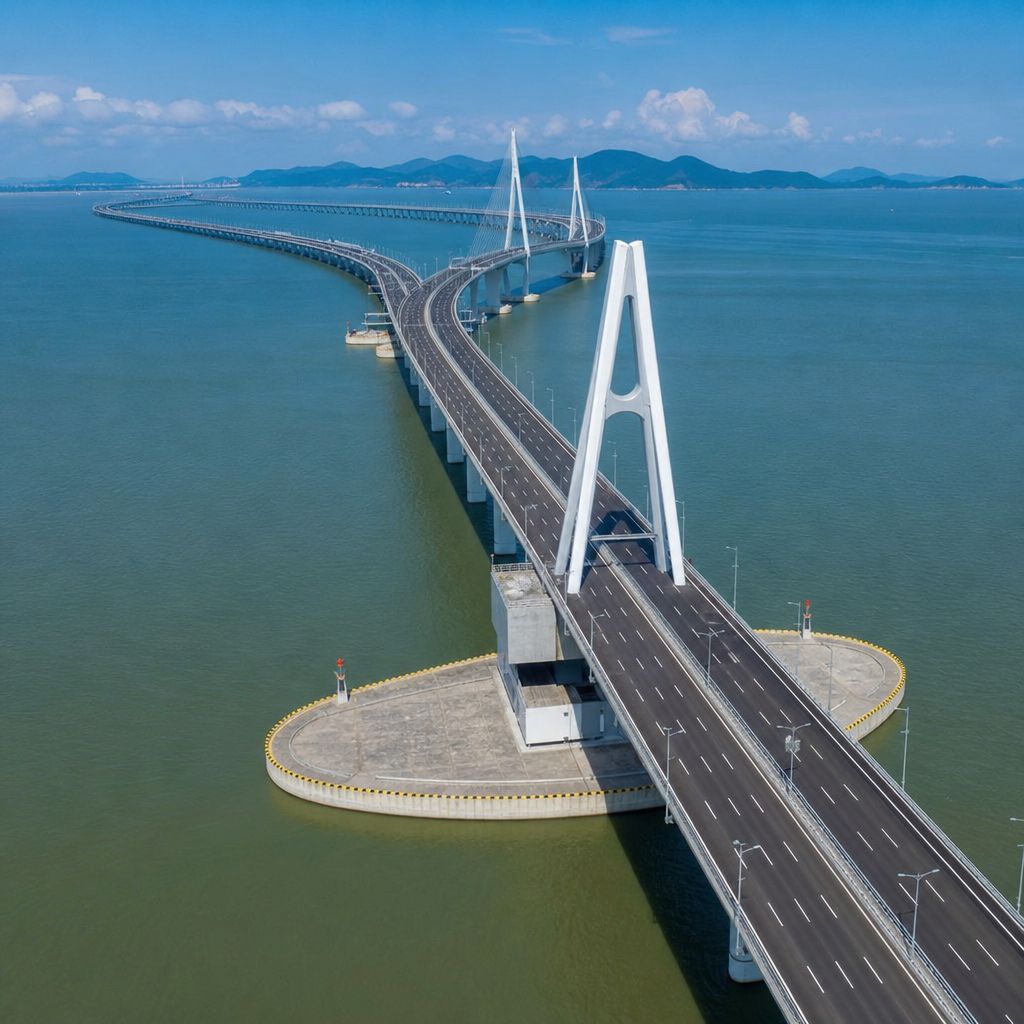
The Hong Kong-Zhuhai-Macao Bridge is a 55-kilometer-long mega-structure that spans the Pearl River Estuary, connecting Hong Kong, Zhuhai in mainland China, and Macao. It is the world's longest sea-crossing bridge and tunnel system, combining viaducts, artificial islands, and an underwater tunnel to navigate complex maritime and geological conditions. The project was conceived to address the growing demand for efficient transport links in the Greater Bay Area, a region that accounts for a significant portion of China's economic output.
The bridge's design incorporates advanced engineering techniques to withstand typhoons, seismic activity, and heavy maritime traffic. Its construction required innovative solutions, such as the use of prefabricated steel structures and deep-sea foundations, to ensure durability and safety. The HZMB is not merely a physical connection but a symbol of regional integration, fostering collaboration between the three jurisdictions it serves.
The project was developed under a collaborative framework involving the governments of Hong Kong, Zhuhai, and Macao, as well as the central Chinese government. This tripartite cooperation was essential to address regulatory, financial, and technical challenges, ensuring the bridge's successful completion. The HZMB also includes immigration and customs facilities at its ports, streamlining cross-border travel and trade while maintaining the distinct legal and administrative systems of each region.
From an economic perspective, the HZMB is expected to reduce travel time between Hong Kong and Zhuhai from approximately four hours to just 40 minutes, significantly boosting efficiency for businesses and commuters. The bridge also enhances the competitiveness of the Greater Bay Area by improving access to ports, airports, and industrial zones, thereby attracting investment and fostering innovation.
Technical Details
The HZMB consists of three main components: a 22.9-kilometer-long bridge section, a 6.7-kilometer-long underwater tunnel, and two artificial islands that serve as transition points between the bridge and tunnel. The bridge section includes a series of viaducts and cable-stayed spans, with the main navigation channel spanned by a 22.8-kilometer-long segment. The tunnel, located between the two artificial islands, was constructed to allow uninterrupted maritime traffic in the busy Pearl River Estuary.
The artificial islands, each covering an area of approximately 100,000 square meters, were built using a pioneering technique known as the "sand compaction pile method." This method involved driving steel cylinders into the seabed to create a stable foundation for the islands, which were then filled with sand and reinforced with concrete. The islands house ventilation facilities for the tunnel and serve as critical nodes for the bridge's structural integrity.
The bridge's design adheres to stringent safety standards, including resistance to wind speeds of up to 200 kilometers per hour and seismic activity of magnitude 8 on the Richter scale. The use of high-performance steel and concrete ensures the structure's longevity, with an expected lifespan of 120 years. Additionally, the HZMB incorporates intelligent monitoring systems to track structural health, traffic conditions, and environmental factors in real time.
Traffic management on the HZMB is facilitated by a closed toll system, with vehicles required to pay fees based on their type and distance traveled. The bridge operates 24 hours a day, with strict speed limits and lane discipline enforced to ensure safety. Emergency response teams and maintenance crews are stationed along the route to address incidents promptly, minimizing disruptions to traffic flow.
Historical Development
The concept of a cross-boundary bridge linking Hong Kong, Zhuhai, and Macao was first proposed in the 1980s, as regional planners sought to capitalize on the economic potential of the Pearl River Delta. However, it was not until the early 2000s that the project gained momentum, driven by China's broader strategy to develop the Greater Bay Area into a global economic powerhouse. The formal agreement to construct the HZMB was signed in 2009, marking the beginning of a decade-long engineering endeavor.
Construction of the HZMB commenced in December 2009, with the project divided into several phases to manage its complexity. The first major milestone was the completion of the artificial islands in 2011, followed by the installation of the bridge's main spans and the underwater tunnel. The project faced numerous challenges, including adverse weather conditions, environmental concerns, and logistical hurdles, which required innovative solutions and close coordination among the participating governments.
The HZMB was officially opened to traffic on October 24, 2018, following a series of rigorous safety inspections and trial operations. The opening ceremony was attended by high-level officials from China, Hong Kong, and Macao, underscoring the project's significance as a symbol of regional cooperation. Since its inauguration, the bridge has played a pivotal role in enhancing connectivity and economic integration in the Greater Bay Area.
Application Area
- Regional Connectivity: The HZMB serves as a critical transport link, reducing travel time and costs for commuters and businesses operating across Hong Kong, Zhuhai, and Macao. It facilitates the movement of people, goods, and services, thereby strengthening economic ties and promoting regional development.
- Logistics and Trade: The bridge enhances the efficiency of supply chains by providing a direct route between major ports, airports, and industrial zones. It supports the growth of cross-border trade and logistics operations, particularly in sectors such as manufacturing, retail, and e-commerce.
- Tourism: The HZMB has opened new opportunities for tourism by making it easier for visitors to explore multiple destinations in the Greater Bay Area. It has contributed to the growth of cross-border tourism, with travelers benefiting from streamlined immigration procedures and improved transport links.
- Urban Development: The bridge has spurred urban development in the surrounding regions, attracting investment in infrastructure, real estate, and commercial projects. It has also encouraged the development of new residential and business districts, particularly in Zhuhai and Macao.
Well Known Examples
- Pearl River Delta Integration: The HZMB is a cornerstone of the Greater Bay Area initiative, which aims to integrate the economies of Hong Kong, Macao, and nine cities in Guangdong Province. The bridge has accelerated the flow of capital, talent, and technology, positioning the region as a global hub for innovation and trade.
- Cross-Border Commuting: The bridge has enabled a new era of cross-border commuting, with workers and students traveling between Hong Kong, Zhuhai, and Macao on a daily basis. This has led to the emergence of a more mobile and interconnected workforce, benefiting industries such as finance, technology, and education.
- Emergency Response: The HZMB has been utilized in emergency response efforts, such as the evacuation of residents during typhoons and the transportation of medical supplies during public health crises. Its robust infrastructure ensures that critical resources can be deployed quickly and efficiently.
Risks and Challenges
- Environmental Impact: The construction of the HZMB raised concerns about its impact on marine ecosystems, particularly the habitats of endangered species such as the Chinese white dolphin. Mitigation measures, including the creation of artificial reefs and restrictions on construction activities, were implemented to minimize environmental damage.
- Safety and Security: The bridge's length and complexity pose challenges for safety and security management. Ensuring the safety of travelers requires continuous monitoring, emergency preparedness, and coordination among multiple agencies. Additionally, the bridge's strategic importance makes it a potential target for security threats, necessitating robust protective measures.
- Regulatory and Legal Issues: The HZMB spans three distinct jurisdictions, each with its own legal and regulatory frameworks. Harmonizing these systems to facilitate smooth cross-border travel and trade has been a complex and ongoing process, requiring close cooperation among the governments involved.
- Maintenance and Upkeep: The bridge's extensive infrastructure requires regular maintenance to ensure its longevity and safety. This includes inspections of structural components, repairs to road surfaces, and updates to intelligent monitoring systems. The cost and logistical challenges of maintenance are significant, particularly given the bridge's scale and exposure to harsh environmental conditions.
Similar Terms
- Oresund Bridge: A combined road and rail link connecting Copenhagen, Denmark, with Malmö, Sweden. Like the HZMB, it is a cross-border infrastructure project designed to enhance regional connectivity and economic integration.
- Channel Tunnel (Chunnel): An underwater rail tunnel linking the United Kingdom and France beneath the English Channel. It serves as a critical transport link for passengers and freight, demonstrating the potential of large-scale infrastructure projects to transform regional mobility.
- Danyang-Kunshan Grand Bridge: The world's longest bridge, located in China, spanning 164.8 kilometers. While primarily a rail bridge, it shares similarities with the HZMB in terms of its scale and engineering complexity.
Summary
The Hong Kong-Zhuhai-Macao Bridge (HZMB) is a landmark infrastructure project that exemplifies the potential of large-scale engineering to transform regional connectivity and economic integration. By linking three major economic hubs, the bridge has reduced travel times, enhanced trade and logistics efficiency, and fostered collaboration across the Greater Bay Area. Its innovative design and construction techniques set new standards for mega-projects, while its strategic importance underscores the role of infrastructure in driving economic growth.
Despite its many benefits, the HZMB also presents challenges, including environmental concerns, safety and security risks, and regulatory complexities. Addressing these challenges requires ongoing cooperation among the governments of Hong Kong, Zhuhai, and Macao, as well as continuous investment in maintenance and innovation. As a symbol of regional unity and progress, the HZMB stands as a testament to the power of infrastructure to shape the future of mobility and development.
--