
English: Hong Kong MTR China / Deutsch: Hong Kong MTR China / Español: Metro de Hong Kong (MTR) en China / Português: MTR de Hong Kong na China / Français: MTR de Hong Kong en Chine / Italiano: MTR di Hong Kong in Cina
The Hong Kong MTR China represents one of the most advanced and efficient urban rail systems in the world, serving as a cornerstone of public transportation in Hong Kong and expanding its influence into mainland China. As a hybrid model of public-private operation, it combines high-capacity transit with commercial development, setting benchmarks for sustainability and operational excellence. Its integration with regional networks underscores its role in shaping mobility across the Greater Bay Area.
General Description
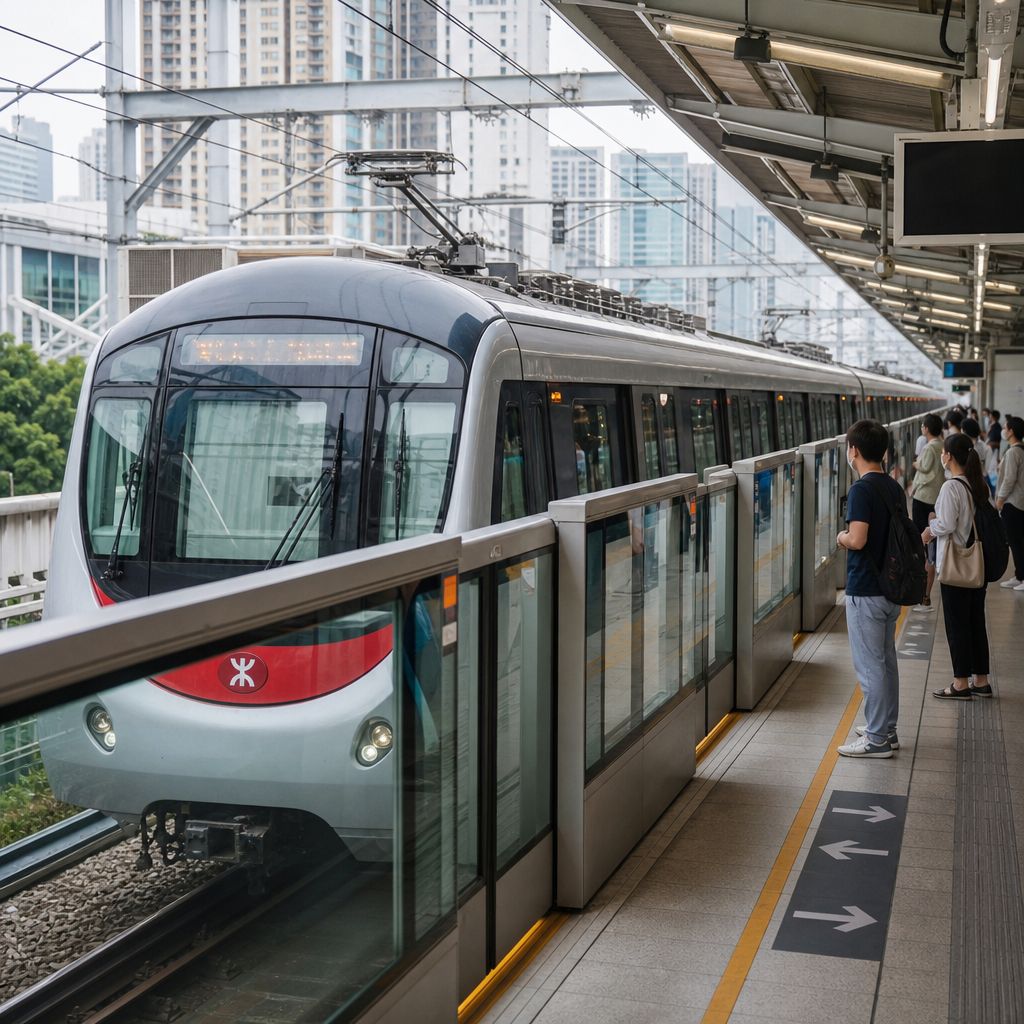
The Hong Kong MTR (Mass Transit Railway) is a rapid transit system that has evolved from a local urban network into a regional mobility powerhouse, particularly through its expansion into mainland China under the umbrella of MTR Corporation Limited. Established in 1975, the MTR initially focused on serving Hong Kong's densely populated urban areas, addressing the challenges of limited land availability and high passenger demand. Over the decades, it has grown into a multimodal transport operator, managing not only rail services but also property development, retail spaces, and international consultancy projects.
The system's operational model is distinguished by its "rail plus property" approach, where revenue from real estate developments along transit corridors subsidizes rail operations. This self-sustaining financial structure has enabled the MTR to maintain high service standards without heavy reliance on government subsidies, a rarity among global transit systems. The network spans over 270 kilometers, with 11 lines serving more than 5 million daily passengers in Hong Kong alone. Its punctuality rate, often exceeding 99.9%, is among the highest in the world, a testament to its robust maintenance protocols and advanced signaling technologies.
Beyond Hong Kong, MTR Corporation has extended its expertise to mainland China, where it operates and manages rail lines in cities such as Beijing, Shenzhen, and Hangzhou. These projects leverage Hong Kong's experience in integrating rail transport with urban planning, while adapting to the unique regulatory and operational environments of mainland China. The corporation's involvement ranges from full ownership and operation to management contracts, reflecting its flexible approach to cross-border collaboration. This expansion aligns with China's broader strategy to develop high-speed rail and urban transit networks, positioning the MTR as a key player in the country's mobility infrastructure.
Technical Specifications and Infrastructure
The Hong Kong MTR's technical infrastructure is designed to maximize efficiency and passenger comfort in a high-density urban environment. The system operates on standard gauge (1,435 millimeters) tracks, compatible with mainland China's rail network, facilitating potential future interoperability. Trains are powered by a 1,500-volt direct current (DC) overhead catenary system, a common standard for urban rail systems, which ensures reliable energy supply even during peak demand periods. The rolling stock varies by line, with newer models featuring regenerative braking systems that recover energy during deceleration, reducing overall power consumption by up to 20%.
Signaling and control systems are a critical component of the MTR's operational reliability. The network employs advanced Communication-Based Train Control (CBTC) technology, which allows for shorter headways between trains and real-time adjustments to service frequencies. This system enhances capacity during rush hours, with some lines operating trains at intervals as short as 90 seconds. Stations are equipped with platform screen doors, a safety feature that prevents accidents and improves climate control within the underground environment. Additionally, the MTR's maintenance depots utilize predictive analytics and condition-based monitoring to minimize downtime and extend the lifespan of critical assets.
In mainland China, the MTR's operations adhere to local technical standards while incorporating best practices from Hong Kong. For example, the Beijing Metro Line 4, managed by MTR, features a similar CBTC system and energy-efficient rolling stock, though it operates on a 750-volt DC third rail power supply, reflecting regional preferences. The Shenzhen Metro Line 4, another MTR-operated line, integrates with the city's broader transit network, including connections to high-speed rail and bus rapid transit (BRT) systems. These projects demonstrate the MTR's ability to adapt its technical expertise to diverse operational contexts while maintaining high service standards.
Historical Development and Expansion
The origins of the Hong Kong MTR trace back to the 1960s, when rapid population growth and urbanization necessitated a modern mass transit system. The first line, the Kwun Tong Line, opened in 1979, marking the beginning of a transformative era for the city's transportation infrastructure. Subsequent expansions in the 1980s and 1990s, including the Tsuen Wan Line and the Island Line, connected key commercial and residential districts, reducing reliance on road transport and alleviating congestion. The 1998 merger with the Kowloon-Canton Railway (KCR) further consolidated the network, integrating suburban rail services into a unified system.
The MTR's expansion into mainland China began in the early 2000s, coinciding with China's rapid urbanization and infrastructure investments. The first major project, the Beijing Metro Line 4, commenced operations in 2009 under a 30-year public-private partnership (PPP) agreement. This model, pioneered in Hong Kong, allowed the MTR to leverage its operational expertise while sharing financial risks with local governments. Subsequent projects in Shenzhen, Hangzhou, and other cities followed a similar approach, with the MTR typically holding minority stakes or management contracts. These ventures have not only expanded the corporation's footprint but also facilitated knowledge transfer between Hong Kong and mainland China.
A significant milestone in the MTR's history was the 2015 launch of the Guangzhou-Shenzhen-Hong Kong Express Rail Link (XRL), a high-speed rail connection that reduced travel time between Hong Kong and Guangzhou to approximately 48 minutes. While the XRL is operated by MTR's subsidiary, Hong Kong Express Rail Link Company Limited, it exemplifies the corporation's role in bridging regional transport networks. The project also highlighted the challenges of cross-border operations, including customs and immigration procedures, which required innovative solutions such as co-located clearance facilities at Hong Kong's West Kowloon Terminus.
Application Area
- Urban Mobility: The Hong Kong MTR serves as the backbone of the city's public transport system, providing reliable and high-capacity connectivity between residential, commercial, and industrial zones. Its integration with other modes of transport, such as buses, trams, and ferries, ensures seamless multimodal journeys for passengers.
- Regional Integration: Through its operations in mainland China, the MTR contributes to the development of the Greater Bay Area, a megalopolis comprising Hong Kong, Macau, and nine cities in Guangdong Province. By improving rail connectivity, it supports economic integration and facilitates cross-border commuting for workers and travelers.
- Property Development: The MTR's "rail plus property" model generates revenue through the development of residential, commercial, and retail spaces above or near stations. This approach not only funds rail operations but also promotes transit-oriented development, reducing urban sprawl and car dependency.
- International Consultancy: Leveraging its expertise, the MTR provides consultancy services to rail projects worldwide, including in the United Kingdom, Australia, and Sweden. These services encompass design, construction, operations, and maintenance, positioning the corporation as a global leader in transit solutions.
Well Known Examples
- Beijing Metro Line 4: One of the MTR's flagship projects in mainland China, this 28-kilometer line serves over 1 million daily passengers. It was the first metro line in Beijing to adopt a PPP model, with MTR holding a 49% stake in the operating company. The line's success has set a precedent for similar collaborations in other Chinese cities.
- Shenzhen Metro Line 4 (Longhua Line): Operated by MTR since 2010, this line connects Shenzhen's Futian District with the suburban Longhua District. It features driverless trains and integrates with the city's broader metro network, including transfers to high-speed rail services. The line's daily ridership exceeds 500,000 passengers.
- Hong Kong International Airport Express: A dedicated rail link connecting Hong Kong's urban centers with the airport, this line exemplifies the MTR's ability to provide high-speed, premium services. Trains operate at speeds of up to 135 kilometers per hour, completing the journey from Hong Kong Station to the airport in approximately 24 minutes.
- Guangzhou-Shenzhen-Hong Kong Express Rail Link (XRL): This 142-kilometer high-speed rail line connects Hong Kong with mainland China's national high-speed rail network. The Hong Kong section, operated by MTR, features a state-of-the-art terminus at West Kowloon, which includes co-located customs and immigration facilities to streamline cross-border travel.
Risks and Challenges
- Cross-Border Regulatory Complexity: Operating in both Hong Kong and mainland China involves navigating distinct legal, regulatory, and political frameworks. Differences in labor laws, safety standards, and government oversight can create operational challenges, particularly for projects spanning both regions.
- Financial Viability of Expansion Projects: While the MTR's "rail plus property" model has proven successful in Hong Kong, replicating this approach in mainland China is challenging due to differences in land ownership and development rights. Some projects have faced delays or cost overruns, impacting profitability.
- Passenger Safety and Security: As ridership continues to grow, ensuring passenger safety remains a priority. The MTR must address risks such as overcrowding, emergency evacuations, and cybersecurity threats to its signaling and control systems. Regular drills and investments in surveillance technology are essential to mitigate these risks.
- Competition from Alternative Transport Modes: The rise of ride-hailing services, bike-sharing, and autonomous vehicles poses a challenge to traditional rail systems. The MTR must innovate to maintain its competitive edge, for example, by enhancing digital ticketing, real-time passenger information, and personalized travel services.
- Environmental and Sustainability Pressures: As a major infrastructure operator, the MTR faces scrutiny over its environmental impact, including energy consumption, noise pollution, and land use. The corporation has committed to reducing its carbon footprint through initiatives such as energy-efficient trains and renewable energy adoption, but these efforts require ongoing investment and innovation.
Similar Terms
- Mass Rapid Transit (MRT): A generic term for high-capacity urban rail systems, often used interchangeably with "metro" or "subway." Examples include the Singapore MRT and the Taipei Metro, which share similarities with the Hong Kong MTR in terms of operational efficiency and integration with urban development.
- Public-Private Partnership (PPP): A collaborative model between government agencies and private companies to finance, build, and operate infrastructure projects. The Hong Kong MTR's operations in mainland China, such as Beijing Metro Line 4, are prime examples of PPPs in the rail sector.
- Transit-Oriented Development (TOD): An urban planning approach that focuses on creating dense, walkable communities centered around public transport hubs. The MTR's "rail plus property" model is a form of TOD, promoting sustainable land use and reducing car dependency.
- Communication-Based Train Control (CBTC): A signaling system that uses wireless communication to manage train movements, enabling higher capacity and shorter headways. The Hong Kong MTR employs CBTC technology across its network to enhance operational efficiency and safety.
Summary
The Hong Kong MTR China exemplifies a successful fusion of urban transit, commercial innovation, and regional integration. From its origins as a local metro system to its current status as a cross-border mobility leader, the MTR has demonstrated unparalleled efficiency, reliability, and adaptability. Its "rail plus property" model has not only ensured financial sustainability but also set a global standard for transit-oriented development. Through strategic expansions into mainland China, the MTR has played a pivotal role in connecting Hong Kong with the Greater Bay Area, fostering economic growth and enhancing regional mobility.
However, the MTR's journey is not without challenges. Navigating cross-border regulations, ensuring financial viability, and addressing environmental concerns require continuous innovation and collaboration. As urbanization and technological advancements reshape the transport landscape, the MTR's ability to evolve will determine its long-term success. Nevertheless, its track record of operational excellence and commitment to sustainability positions it as a model for modern transit systems worldwide.
--