
Deutsch: Stationen der Kopenhagener Metro / Español: Estaciones del Metro de Copenhague / Português: Estações do Metrô de Copenhague / Français: Stations du Métro de Copenhague / Italiano: Stazioni della Metropolitana di Copenaghen
The Copenhagen Metro Stations represent a cornerstone of modern urban transportation in Denmark's capital, integrating efficiency, sustainability, and architectural innovation. As a fully automated metro system, the network serves as a model for public transit solutions in medium-sized cities, balancing high capacity with minimal environmental impact. Its stations are not merely functional nodes but also reflect the city's commitment to accessibility and urban design.
General Description
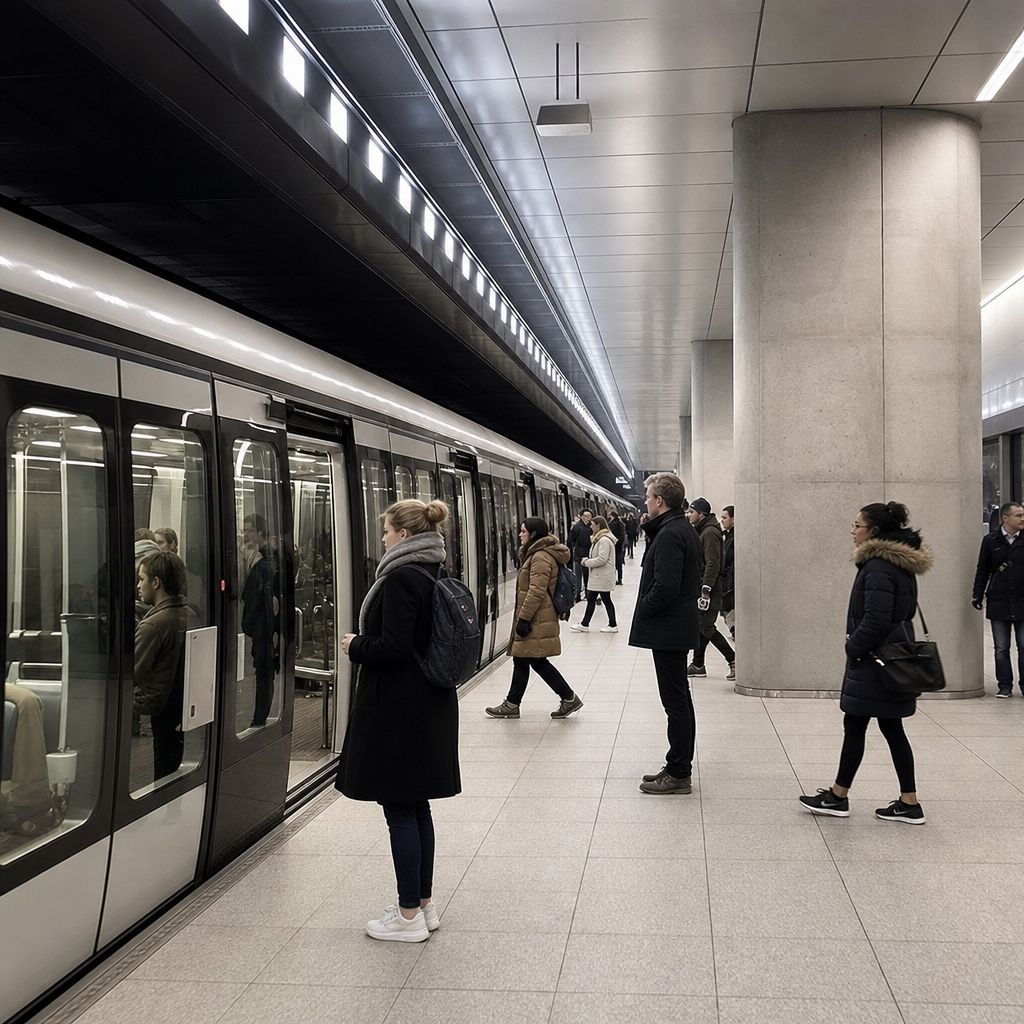
The Copenhagen Metro Stations form the backbone of one of the world's most advanced driverless metro systems, operational since 2002. Designed to alleviate traffic congestion and reduce carbon emissions, the network currently comprises four lines (M1, M2, M3, and M4) with a total of 39 stations, including underground, at-grade, and elevated platforms. The system is characterized by its high frequency, with trains arriving every 2–4 minutes during peak hours, ensuring seamless connectivity across key districts such as Ørestad, Amager, and the city center.
The stations are engineered to prioritize passenger flow, featuring platform screen doors (PSDs) that enhance safety and energy efficiency by preventing unauthorized access to tracks. This design also allows for climate control within the stations, maintaining comfortable temperatures year-round. Architecturally, the stations adhere to a minimalist aesthetic, often incorporating natural light through skylights or glass facades, which reduces energy consumption for artificial lighting. Materials such as stainless steel, concrete, and glass dominate the interiors, creating a clean, modern atmosphere that aligns with Copenhagen's broader urban sustainability goals.
Accessibility is a defining feature of the Copenhagen Metro Stations. All platforms are equipped with elevators, escalators, and tactile paving to accommodate passengers with disabilities or reduced mobility. Additionally, real-time information displays and audio announcements provide updates in multiple languages, ensuring inclusivity for international travelers. The stations are also integrated with other modes of transport, including buses, regional trains, and cycling infrastructure, facilitating multimodal journeys. This interconnectedness is a key factor in the metro's success, as it encourages residents and visitors to rely on public transit rather than private vehicles.
The operational efficiency of the Copenhagen Metro Stations is underpinned by advanced technologies, such as automatic train control (ATC) and centralized monitoring systems. These systems enable remote oversight of train movements, station operations, and passenger flows, minimizing delays and optimizing energy use. The metro's automation also reduces labor costs and human error, contributing to its reputation for reliability. Furthermore, the stations are designed to handle future expansions, with provisions for additional lines or increased train frequencies as demand grows.
Technical Specifications
The Copenhagen Metro Stations are built to stringent technical standards to ensure safety, durability, and performance. Platforms are typically 60 meters long, accommodating trains with three carriages, each capable of carrying up to 300 passengers. The track gauge is 1,435 millimeters (standard gauge), consistent with most European rail networks, facilitating potential future interoperability with regional rail systems. Stations are constructed using reinforced concrete and steel frameworks, designed to withstand the region's climatic conditions, including freeze-thaw cycles and high winds.
Energy efficiency is a critical aspect of the stations' design. Heating and cooling systems are powered by district heating and renewable energy sources, such as wind power, aligning with Copenhagen's goal of becoming carbon-neutral by 2025. Lighting is predominantly LED-based, with motion sensors in less frequented areas to conserve electricity. The platform screen doors, a hallmark of the system, not only improve safety but also reduce energy loss by maintaining a controlled environment within the stations. These doors are synchronized with train arrivals and departures, opening only when a train is fully stopped at the platform.
Fire safety is another priority, with stations equipped with sprinkler systems, smoke detectors, and emergency exits designed to evacuate passengers within 90 seconds. The underground stations, in particular, feature pressurized ventilation systems to prevent smoke accumulation in the event of a fire. Additionally, all stations are monitored 24/7 by a central control room, which can initiate emergency protocols, such as train rerouting or station closures, if necessary.
Historical Development
The Copenhagen Metro was conceived in the 1990s as part of a broader urban development strategy to revitalize the Ørestad district, a former industrial area slated for transformation into a modern business and residential hub. The first phase of the metro, comprising lines M1 and M2, opened in 2002, connecting the city center to Amager and Ørestad. This initial network included 22 stations, many of which were designed by renowned architectural firms such as KHR Arkitekter and Vilhelm Lauritzen Architects, who emphasized functionality and aesthetic harmony with Copenhagen's urban landscape.
The success of the first phase led to subsequent expansions. In 2007, the metro was extended to Copenhagen Airport, enhancing connectivity for international travelers. The most significant expansion occurred in 2019 with the inauguration of the Cityringen (M3), a 15.5-kilometer loop line serving 17 new stations, including key locations such as Kongens Nytorv, Frederiksberg, and Nørrebro. This project, one of the largest infrastructure undertakings in Denmark's history, required extensive tunneling beneath historic neighborhoods, posing engineering challenges that were overcome through the use of tunnel boring machines (TBMs) and meticulous urban planning.
The latest addition to the network, the M4 line, began operations in 2020, connecting the city center to the Nordhavn district, a rapidly developing waterfront area. Future plans include further extensions to the M4 line, as well as potential new lines to serve growing suburbs. The metro's development has been closely tied to Copenhagen's population growth and urban sprawl, with each expansion aimed at reducing car dependency and promoting sustainable mobility.
Application Area
- Urban Mobility: The Copenhagen Metro Stations serve as critical nodes in the city's public transport network, providing high-frequency, reliable service to over 100 million passengers annually. They facilitate daily commutes for residents, reducing travel times and alleviating road congestion.
- Economic Development: By connecting business districts, residential areas, and educational institutions, the stations stimulate economic activity and attract investment. The Ørestad district, in particular, has experienced significant growth due to its metro accessibility, becoming a hub for corporate headquarters and innovation centers.
- Tourism and Hospitality: The metro's integration with Copenhagen Airport and major tourist attractions, such as Tivoli Gardens and the Little Mermaid, enhances the city's appeal to visitors. Stations like Kongens Nytorv and Nørreport serve as gateways to historic neighborhoods, encouraging exploration on foot or by bicycle.
- Environmental Sustainability: The metro's electric-powered trains and energy-efficient stations contribute to Copenhagen's climate goals by reducing greenhouse gas emissions. The system's design encourages modal shift from private cars to public transit, further lowering the city's carbon footprint.
- Emergency Response: In addition to daily operations, the metro stations are designed to support emergency evacuations or disaster response efforts. Their robust infrastructure and centralized monitoring systems enable rapid coordination with municipal authorities during crises.
Well Known Examples
- Kongens Nytorv: Located in the heart of Copenhagen, this station serves as a major interchange between the M1, M2, and M3 lines. Its design incorporates a large glass atrium, allowing natural light to flood the underground platforms, and it is situated near landmarks such as the Royal Danish Theatre and Nyhavn.
- Nørreport: One of the busiest stations in the network, Nørreport connects the metro to regional trains (S-tog) and buses, making it a vital transit hub. The station's above-ground structures are integrated into a pedestrian-friendly plaza, enhancing urban connectivity.
- Copenhagen Airport (Lufthavnen): This station provides a direct link between the metro and Kastrup Airport, offering travelers a seamless 15-minute journey to the city center. Its design prioritizes passenger flow, with clear signage and short walking distances to airport terminals.
- Ørestad: A key station in the Ørestad district, this stop serves as a gateway to the University of Copenhagen's South Campus and the Field's shopping center. Its elevated platform offers panoramic views of the surrounding area, blending urban and natural landscapes.
- Marble Church (Marmorkirken): Named after the nearby Frederik's Church, this station on the M3 line is notable for its proximity to historic sites and its role in serving the diplomatic quarter. Its underground design minimizes visual impact on the surrounding architecture.
Risks and Challenges
- Overcrowding: As ridership continues to grow, some stations, particularly during peak hours, face challenges related to passenger congestion. This can lead to delays and reduced comfort, necessitating ongoing capacity upgrades, such as longer trains or additional platforms.
- Construction Disruptions: Expansions and maintenance work can cause temporary disruptions to service, affecting commuters and businesses. Effective communication and alternative transport arrangements are essential to mitigate these impacts.
- Cybersecurity Threats: The metro's reliance on automated systems and digital infrastructure exposes it to potential cyberattacks. Robust security protocols and regular system audits are required to safeguard operations and passenger data.
- Climate Resilience: Rising sea levels and extreme weather events pose risks to underground stations, particularly those in low-lying areas. Flood barriers and drainage systems are critical to protecting the network from water damage.
- Urban Integration: Balancing the metro's expansion with the preservation of historic neighborhoods and green spaces requires careful planning. Community engagement and transparent decision-making processes are vital to address concerns about noise, vibration, and visual impact.
- Energy Consumption: While the metro is designed to be energy-efficient, its overall electricity demand is significant. Transitioning to 100% renewable energy sources remains a challenge, though ongoing investments in wind and solar power aim to address this.
Similar Terms
- Driverless Metro Systems: Automated metro networks, such as those in Singapore, Dubai, and Paris, share similarities with the Copenhagen Metro in terms of technology and operational efficiency. These systems eliminate the need for human drivers, reducing labor costs and improving punctuality.
- Urban Transit Hubs: Major transit centers, like London's King's Cross or Tokyo's Shinjuku Station, serve as multimodal interchange points, integrating metro, rail, and bus services. While larger in scale, they share the Copenhagen Metro Stations' focus on passenger flow and accessibility.
- Platform Screen Doors (PSDs): Used in metros worldwide, PSDs enhance safety by preventing falls onto tracks and improving climate control within stations. The Copenhagen Metro was among the first in Europe to implement this technology system-wide.
- Sustainable Urban Mobility: Concepts such as "transit-oriented development" (TOD) and "mobility-as-a-service" (MaaS) align with the principles underlying the Copenhagen Metro. These approaches prioritize public transit, walking, and cycling to create livable, low-carbon cities.
Summary
The Copenhagen Metro Stations exemplify the integration of cutting-edge technology, sustainable design, and urban functionality in public transportation. As a fully automated system, they offer high-frequency service, accessibility, and seamless connectivity across Copenhagen's key districts, supporting the city's economic and environmental goals. The stations' technical innovations, such as platform screen doors and energy-efficient infrastructure, set benchmarks for metro systems worldwide, while their architectural minimalism reflects the city's commitment to aesthetic harmony. Despite challenges like overcrowding and climate resilience, the metro remains a vital component of Copenhagen's mobility strategy, demonstrating how public transit can drive urban development while reducing reliance on private vehicles. As the network continues to expand, it will play an increasingly central role in shaping the future of sustainable cities.
--
Sources: Copenhagen Metro Company (2023), "Metro Development Plan"; European Environment Agency (2022), "Urban Mobility and Climate Change"; International Association of Public Transport (UITP) (2021), "Automated Metros: Global Trends and Best Practices."