
Deutsch: Jungfernstieg, Hamburg, Deutschland / Español: Jungfernstieg, Hamburgo, Alemania / Português: Jungfernstieg, Hamburgo, Alemanha / Français: Jungfernstieg, Hambourg, Allemagne / Italiano: Jungfernstieg, Amburgo, Germania
The Jungfernstieg, Hamburg, Germany, is one of the most iconic and historically significant urban spaces in Northern Europe. Situated along the Binnenalster, a picturesque inner-city lake, this boulevard serves as a central hub for transport, commerce, and public life in Hamburg. While primarily known for its cultural and architectural heritage, the Jungfernstieg also plays a crucial role in the city's mobility infrastructure, linking pedestrian zones, public transport networks, and waterborne logistics. Its strategic location and multifunctional design make it a key case study in urban planning and sustainable mobility.
General Description
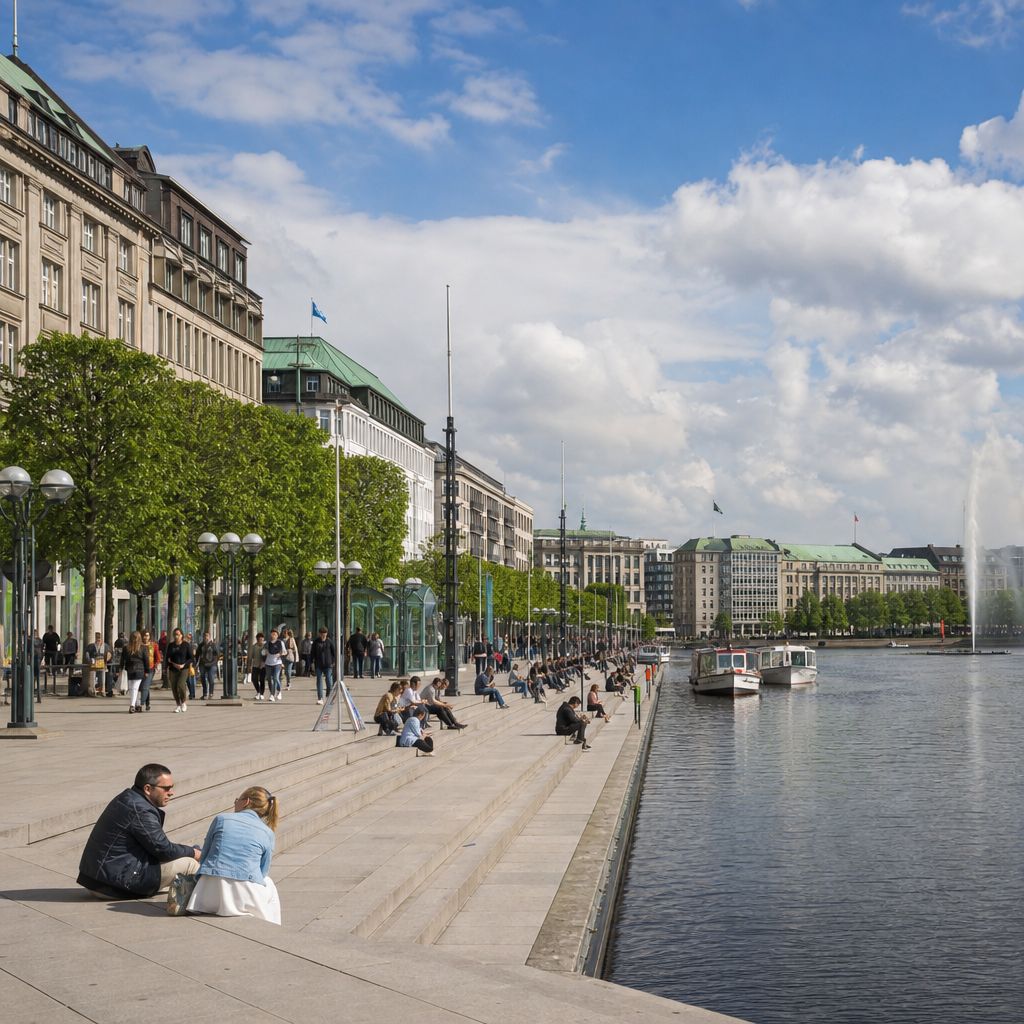
The Jungfernstieg is a prominent boulevard in the heart of Hamburg, stretching approximately 600 meters along the southwestern shore of the Binnenalster. Originally developed in the 17th century as a promenade for Hamburg's elite, the area has evolved into a dynamic urban space that balances historical preservation with modern functionality. The boulevard is characterized by its elegant architecture, including neoclassical facades, luxury hotels, and flagship retail stores, which reflect Hamburg's status as a global commercial hub. The Jungfernstieg is not only a tourist attraction but also a vital artery for daily commuters, shoppers, and visitors, integrating seamlessly with the city's broader transport ecosystem.
The design of the Jungfernstieg prioritizes pedestrian accessibility, with wide sidewalks, open plazas, and landscaped areas that encourage foot traffic. This pedestrian-first approach aligns with Hamburg's broader urban mobility strategy, which aims to reduce car dependency and promote sustainable modes of transport. The boulevard's proximity to the Binnenalster also facilitates water-based mobility, with ferry terminals and boat tours operating year-round. Additionally, the Jungfernstieg serves as a node for Hamburg's public transport network, connecting underground metro lines (U-Bahn), suburban rail (S-Bahn), and bus routes, ensuring seamless multimodal connectivity for residents and visitors alike.
From a logistical perspective, the Jungfernstieg is less about freight movement and more about the efficient flow of people. However, its role in supporting Hamburg's service economy—particularly retail, hospitality, and tourism—makes it an indirect but critical component of the city's supply chains. The area's high footfall generates demand for goods and services, which in turn relies on just-in-time deliveries and urban logistics solutions. The challenge lies in balancing these commercial needs with the preservation of the boulevard's aesthetic and environmental qualities, a task that requires careful urban planning and traffic management.
Historical Development
The origins of the Jungfernstieg date back to 1665, when the city of Hamburg initiated the expansion of its fortifications and the creation of a promenade along the newly formed Binnenalster. The name "Jungfernstieg" (literally "Maidens' Path") is derived from the tradition of young women from Hamburg's bourgeoisie strolling along the boulevard to see and be seen. Over the centuries, the area evolved from a leisurely walkway into a symbol of Hamburg's economic prosperity and cultural identity. In the 19th century, the Jungfernstieg became a focal point for urban modernization, with the construction of grand buildings such as the Alsterpavillon and the Hotel Vier Jahreszeiten, which still stand today.
The 20th century brought further transformations, including the integration of public transport infrastructure. The opening of the U-Bahn station "Jungfernstieg" in 1931 marked a significant milestone, as it connected the boulevard to Hamburg's growing underground network. Post-World War II, the Jungfernstieg underwent extensive reconstruction to restore its pre-war elegance while accommodating the needs of a rapidly expanding city. In the 1970s and 1980s, urban planners introduced traffic-calming measures to reduce vehicle congestion and enhance pedestrian safety, a trend that has continued into the 21st century with the expansion of car-free zones and the promotion of cycling.
Today, the Jungfernstieg is a testament to Hamburg's ability to adapt its historical spaces to contemporary demands. Recent redevelopment projects have focused on improving accessibility, such as the installation of barrier-free pathways and the enhancement of public transport links. The boulevard's historical significance is also preserved through strict architectural guidelines, ensuring that new developments complement the existing urban fabric. This blend of tradition and innovation makes the Jungfernstieg a model for other cities seeking to revitalize their historic centers while meeting modern mobility challenges.
Urban Mobility and Transport Infrastructure
The Jungfernstieg is a critical node in Hamburg's transport network, serving as a multimodal interchange that connects various forms of public and private transport. At its core is the U-Bahn station "Jungfernstieg," which is one of the busiest in Hamburg's metro system, with over 100,000 passengers passing through daily (source: Hamburger Hochbahn AG, 2022). The station provides direct access to three U-Bahn lines (U1, U2, and U3), linking the city center to residential districts, business hubs, and major transport hubs such as Hamburg Hauptbahnhof (central station) and Hamburg Airport. This connectivity is further enhanced by the adjacent S-Bahn station "Jungfernstieg," which offers suburban rail services to the wider metropolitan region.
In addition to rail transport, the Jungfernstieg is a major hub for bus services, with multiple lines operating along the boulevard and its surrounding streets. The integration of bus, metro, and rail services is facilitated by a unified ticketing system, the HVV (Hamburger Verkehrsverbund), which allows passengers to transfer seamlessly between different modes of transport. This multimodal approach reduces reliance on private vehicles and supports Hamburg's goal of becoming a car-free city center by 2030. The boulevard's design also accommodates cycling, with dedicated bike lanes and rental stations for Hamburg's public bike-sharing system, "StadtRAD."
Waterborne transport is another key aspect of the Jungfernstieg's mobility infrastructure. The Binnenalster is served by a fleet of passenger ferries and tourist boats, which provide an alternative mode of transport for commuters and visitors. The Alster ferries, operated by the ATG Alster-Touristik GmbH, connect the Jungfernstieg to other parts of the city, including the Außenalster and the Alster River. These services not only offer a scenic route through Hamburg but also contribute to the reduction of road traffic, particularly during peak hours. The integration of water transport into the city's mobility network is a unique feature of Hamburg, reflecting its maritime heritage and commitment to sustainable urban development.
Application Area
- Urban Mobility and Public Transport: The Jungfernstieg serves as a central transfer point for Hamburg's public transport system, facilitating the movement of thousands of passengers daily. Its role as a multimodal hub supports the city's efforts to reduce car dependency and promote sustainable mobility solutions, such as walking, cycling, and public transport.
- Tourism and Hospitality: As one of Hamburg's most visited landmarks, the Jungfernstieg attracts millions of tourists annually. The boulevard's proximity to hotels, restaurants, and cultural attractions makes it a key driver of the city's hospitality industry, generating demand for services and logistics related to tourism.
- Retail and Commerce: The Jungfernstieg is home to flagship stores, luxury boutiques, and department stores, making it a premier shopping destination. The high footfall in the area supports the local economy and requires efficient urban logistics to manage the flow of goods and services.
- Urban Planning and Sustainability: The boulevard exemplifies Hamburg's approach to sustainable urban development, with a focus on pedestrian-friendly design, green spaces, and the integration of public transport. It serves as a case study for other cities seeking to balance historical preservation with modern mobility needs.
Well Known Examples
- Alsterpavillon: A historic café and restaurant located on the Jungfernstieg, the Alsterpavillon has been a landmark since the 18th century. It is a popular gathering spot for locals and tourists, offering panoramic views of the Binnenalster and serving as a symbol of Hamburg's cultural heritage.
- Hotel Vier Jahreszeiten: One of Hamburg's most luxurious hotels, the Hotel Vier Jahreszeiten has been a fixture on the Jungfernstieg since 1897. It is renowned for its opulent architecture and world-class hospitality, attracting high-profile guests from around the globe.
- U-Bahn Station "Jungfernstieg": As one of the busiest metro stations in Hamburg, this underground hub connects three U-Bahn lines and serves as a vital link in the city's public transport network. Its design incorporates modern amenities while preserving the historical character of the surrounding area.
- Alsterarkaden: A series of neoclassical arcades located near the Jungfernstieg, the Alsterarkaden house a variety of shops, cafés, and offices. The arcades are a prime example of Hamburg's architectural heritage and contribute to the boulevard's vibrant commercial atmosphere.
- Alster Ferries: The passenger ferries operating on the Binnenalster provide a unique mode of transport for commuters and tourists. These services are an integral part of Hamburg's mobility network, offering a sustainable alternative to road-based transport.
Risks and Challenges
- Pedestrian Congestion: The Jungfernstieg's popularity as a tourist destination and commercial hub can lead to overcrowding, particularly during peak hours and special events. Managing pedestrian flows while maintaining safety and accessibility is an ongoing challenge for urban planners.
- Balancing Commercial and Public Interests: The boulevard's high commercial value attracts significant investment from retailers and developers, which can sometimes conflict with the need to preserve public spaces and historical architecture. Striking a balance between economic growth and urban preservation requires careful regulation and community engagement.
- Environmental Impact: The concentration of transport infrastructure and commercial activity on the Jungfernstieg contributes to air pollution and noise levels. Hamburg's efforts to promote sustainable mobility, such as expanding bike lanes and pedestrian zones, are critical to mitigating these environmental impacts.
- Climate Resilience: As a waterfront area, the Jungfernstieg is vulnerable to the effects of climate change, including rising water levels and extreme weather events. Adaptation measures, such as flood barriers and green infrastructure, are essential to protect the boulevard and its surrounding areas from future climate risks.
- Accessibility and Inclusivity: While the Jungfernstieg has made progress in improving accessibility for people with disabilities, challenges remain in ensuring that all public spaces and transport facilities are fully inclusive. Ongoing investments in barrier-free design and infrastructure are necessary to address these gaps.
Similar Terms
- Promenade: A promenade is a paved public walkway, typically located along a waterfront or in a park, designed for leisurely strolling. Like the Jungfernstieg, promenades often serve as social and cultural hubs in urban areas, though they may not always integrate transport infrastructure to the same extent.
- Urban Plaza: An urban plaza is an open public space in a city, often surrounded by buildings and used for gatherings, events, or commerce. While plazas share similarities with the Jungfernstieg in terms of their role as social and economic centers, they may lack the transport connectivity and historical significance of the boulevard.
- Multimodal Transport Hub: A multimodal transport hub is a location where multiple forms of transport, such as rail, bus, and cycling, converge to facilitate passenger transfers. The Jungfernstieg functions as such a hub, though its additional roles in commerce, tourism, and urban planning distinguish it from purely functional transport nodes.
- Waterfront Development: Waterfront development refers to the planning and construction of urban areas along rivers, lakes, or coastlines. The Jungfernstieg is an example of a waterfront development that integrates mobility, commerce, and cultural heritage, though not all waterfront projects prioritize these elements equally.
Summary
The Jungfernstieg in Hamburg, Germany, is a multifaceted urban space that exemplifies the intersection of transport, logistics, and mobility with historical preservation and modern urban planning. As a central hub for public transport, pedestrian movement, and waterborne mobility, it plays a pivotal role in Hamburg's broader strategy to create a sustainable and accessible city. The boulevard's rich history, architectural elegance, and commercial vitality make it a unique case study in balancing the demands of tourism, retail, and daily commuting while addressing challenges such as congestion, environmental impact, and climate resilience. By integrating multimodal transport solutions and prioritizing pedestrian-friendly design, the Jungfernstieg serves as a model for other cities seeking to revitalize their historic centers in a way that meets contemporary mobility needs.
--